About
Understanding Human Experience: What Does It Take for a Human to Truly Reach Out?
We talk about reaching out as though it is the easy part. Ask for help. Speak up. Connect. Seek support. The encouragement is everywhere — and yet, for so many people, that first step is the hardest thing of all. Shame, fear, gender expectations, self-criticism, procrastination, emotional overwhelm, loneliness, trauma and past experience can all shape whether someone feels able to take it. The distance between needing help and asking for it is rarely a matter of willpower. It is human, and it is complicated.
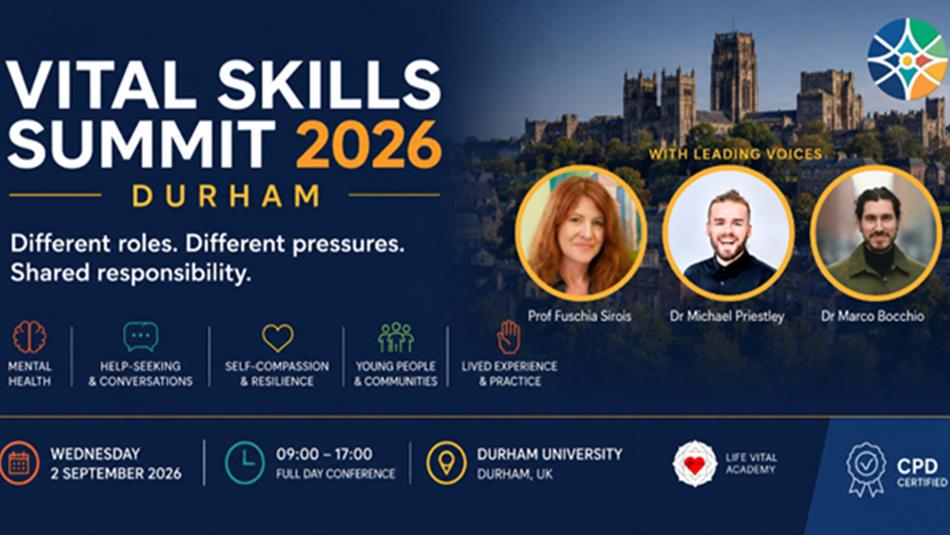
The Vital Skills Summit 2026, held at the world-renowned Durham University, is a fully CPD-accredited day dedicated to understanding that distance. Bringing together leading academic research and powerful lived experience, the summit explores one of the most important questions in mental health, wellbeing and human support: what does it take for a person to truly reach out?
Across the day, delegates will hear from prominent academic voices. Professor Fuschia Sirois examines common humanity, self-compassion and procrastination — and how self-criticism, shame and delay can quietly shape whether we cope or seek support. Dr Michael Priestley explores how gender norms influence wellbeing, communication and help-seeking, why people may stay silent or minimise their distress, and how safer spaces can help them speak openly, sooner. Dr Marco Bocchio shares emerging research into psychedelic and non-psychedelic treatments for depression and anxiety, and what the latest science may mean for the future of support and recovery.
Academic insight alone, however, can only tell part of the story. The summit is grounded in the reality of lived experience, including a first-hand account of what it means to live with a mental health condition, to lose control to the very services designed to help, and to navigate fear, vulnerability, identity and the deep need to be truly heard. It is this combination of rigorous research and honest human testimony that gives the day its depth.
Alongside the keynotes, a series of practical "Skills in Action" sessions translate understanding into everyday practice. These include how to respond when someone reaches out to you — what to say, what to avoid, and how to listen without rushing to fix; supporting the mental health of young people; building resilience in a changing world; and the lasting effects of intensive-care psychosis. The day closes with a keynote question-and-answer session — "What do we do on Monday?" — connecting academic insight with lived experience and real-world practice.
This is not a traditional mental health conference. It is a deeper exploration of the human condition: why people stay silent, why they delay seeking help, what makes connection feel possible, and how professionals, organisations and communities can create environments where people feel safe enough to reach out.
The summit is designed for professionals across health, care, social work, education, leadership, safeguarding, charities, public services, wellbeing and community support — anyone whose work depends, in some way, on people feeling able to speak. It offers an academically grounded and deeply human opportunity to understand what sits beneath behaviour, and what it truly takes for someone to feel seen, heard and supported.
The Vital Skills Summit 2026 takes place on Wednesday 2 September 2026, from 09:00 to 17:00, at Durham University. Tickets are £150 and include full CPD accreditation.
.png )





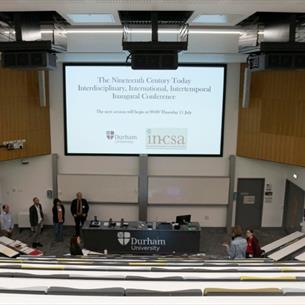 Teaching and Learning Centre, Durham CityFrom international residential conferences, to formal banquets and wedding receptions, Durham's unique qualities are guaranteed to make any event a successful and memorable occasion. We can provide you with a dedicated service, tailored to your specific needs.
 Find out what’s happening this week across the Culture County. From festivals and exhibitions, to sport and theatre, you’re certain to have an eventful time in Durham.